- Dr Aron Choi
- Posts
- A Cautionary Tale of Health Influencers Betraying Public Trust And Why You Must Think For Yourself
A Cautionary Tale of Health Influencers Betraying Public Trust And Why You Must Think For Yourself
Navigating the messy world of health information, misinformation, and contradicting voices.

Aron Choi ND
February 05, 2026

In this newsletter:
Dr. Peter Attia’s betrayal of public trust…and he will not be the last example
How health experts and institutions leverage authority bias for manipulation
Simple disciplines to choose trusted guides, avoid compromised health influencers, and navigate conflicting information
This week, the United States Department of Justice released an additional 3 million pages of the Epstein Files and a prominent doctor and best selling author, Dr. Peter Attia, had over 1729 mentions within the file, including email correspondence with Jeffrey Epstein.
Let’s say that while there are implications and allegations, time will tell what Attia’s involvement was with Epstein.
What we can say for certain is that Peter Attia worked with and met with Jeffrey Epstein years after Epstein had been "convicted in 2008 by a Florida state court of procuring a child for prostitution and soliciting a prostitute, following allegations that he sexually abused girls as young as 14."
The emails between Attia and Epstein were dated nearly 7 years after details about Epstein’s character were well established.
Whether you followed Peter Attia or not, this is an important lesson in being discerning about who you look to for guidance. This is just one cautionary tale and likely not the last.
So what can we learn from all of this?
How Health Experts And Institutions Leverage Authority Bias For Manipulation
Having been in the professional health and medicine world for 15 years, I have learned from a lot of different people.
I have teachers and mentors who I personally studied with and have also learned from prominent doctors and health influencers from afar.
Within any community, there are certain people that rise to the top of the industry for their expertise and reputation.
Many times, their reputation has been earned through their work and contributions to the field. But in the world of social media, private interests, and online marketing (which I also have professional experience in), there are ways to manufacture or at least exaggerate perceived credibility and expertise through carefully constructed public relations campaigns.
Being able to say you appeared on the cover of a magazine, spoke on a stage, or on a big news TV show can be huge for perceived credibility.
This is also how the modern Eminence Based Medical System is set up to bolster the position of doctors in your mind. This is a system where the doctor is the authority and you should do what he or she says. They say this is necessary for "compliance." I’ve always had a problem with this point of view because it stems from a sense of superiority or "we know what is best for you."
The Milgram Experiment showed just how susceptible we are to submitting to authority.
This is especially important (and lucrative) when you need to get a large number of people to be obedient (i.e. getting vaccinated or taking a medication).
You can see this blatantly being used in infomercials and commercials where their is someone who looks like a doctor, white coat and stethoscope around his neck, and in tiny print it says, "This is a paid actor portraying a doctor."
Or you will see a respected celebrity or athlete endorse a product, like tennis legend Serena Williams endorsing weight loss drugs.
The very image of the white coat or seeing our favorite celebrity tricks our mind into seeing this person as an authority figure and expert. Therefore, everything they endorse must be trustworthy, right?
Which is one of the reasons why you will never see a picture of me in a white coat with a stethoscope around my neck out of context.
This plays on a human cognitive biases, and I think it’s unethical.
Cognitive biases are like small glitches in our human programming that helps us navigate our world and make decisions, but can be overridden by those who understand them to steer our behavior.
In the case of recent news, it shows how powerful authority bias runs rampant in health and medicine. When a doctor appears on TV or are endorsed by other people with perceived credibility, it’s easy to think, "wow, this person must be really smart!"
While this type of credibility is one credibility signal, it cannot be the only indicator we use to judge whether the information we are applying to something as important to us as our health.
It is easy to latch onto a person or philosophy that can border on dogmatic and once you view someone as an expert in one area and assume they are an expert in all areas.
One thing I have become especially clear to me—no one expert knows everything.
The Importance of Thinking For Yourself
If I have learned anything since the COVID-19 era, is the importance of thinking for ourselves.
Looking back at 2020, this was one of the biggest tests to my own level of discernment and critical thinking. There was so much doom and gloom and conflicting information on the news, amongst colleagues, and friends and family.
I had people say that it would be my fault if my wife died if we chose not to get the vaccine. (Luckily, we’re still here!)
People were strong-armed into getting the vaccine by threatening to have their jobs and livelihoods taken away from them—a form of tyranny.
Anthony Fauci was on TV doing interviews with our heroes (like Stephen Curry) to encourage us to get our shots.
In the end, I made a decision for myself based on my own critical thinking, even if I wasn’t one hundred percent certain. I’m willing to use my own judgment and bet on myself. I understand that it is not easy to do this.
What that whole experience taught me was that decision making takes up a lot of mental energy and emotional discipline. It is hard to decide what is right for you when the herd looks like it is predominantly going in a completely different direction.
My stance and the Hippocratic Oath I took dictates that each individual must be allowed to have fully informed consent and must be allowed to make their own decisions based on their values and judgment.
However, this human right comes a lot of responsibility and willingness to sit with information that makes us uncomfortable and seems to contradict what we think we know.
It is hard to think for ourselves, but I would rather deal with the discomfort of wading through a mess of information to come as close to the truth as possible than to put my health and wellbeing in the hands of someone else.
Simple Disciplines To Choose Trusted Guides, Avoid Misguided Health Influencers, And Navigate Conflicting Information
I can look back at my last 15 years and see where I made mistakes and where my decisions turned out to be right.
What has worked for me is developing mental discipline and learning from where I was admittedly being stupid. That’s why I started writing down important principles that helped me navigate life…and be less stupid. This means being humble, staying curious, and developing mental frameworks that act as checks and balances and that help sort signal from noise.
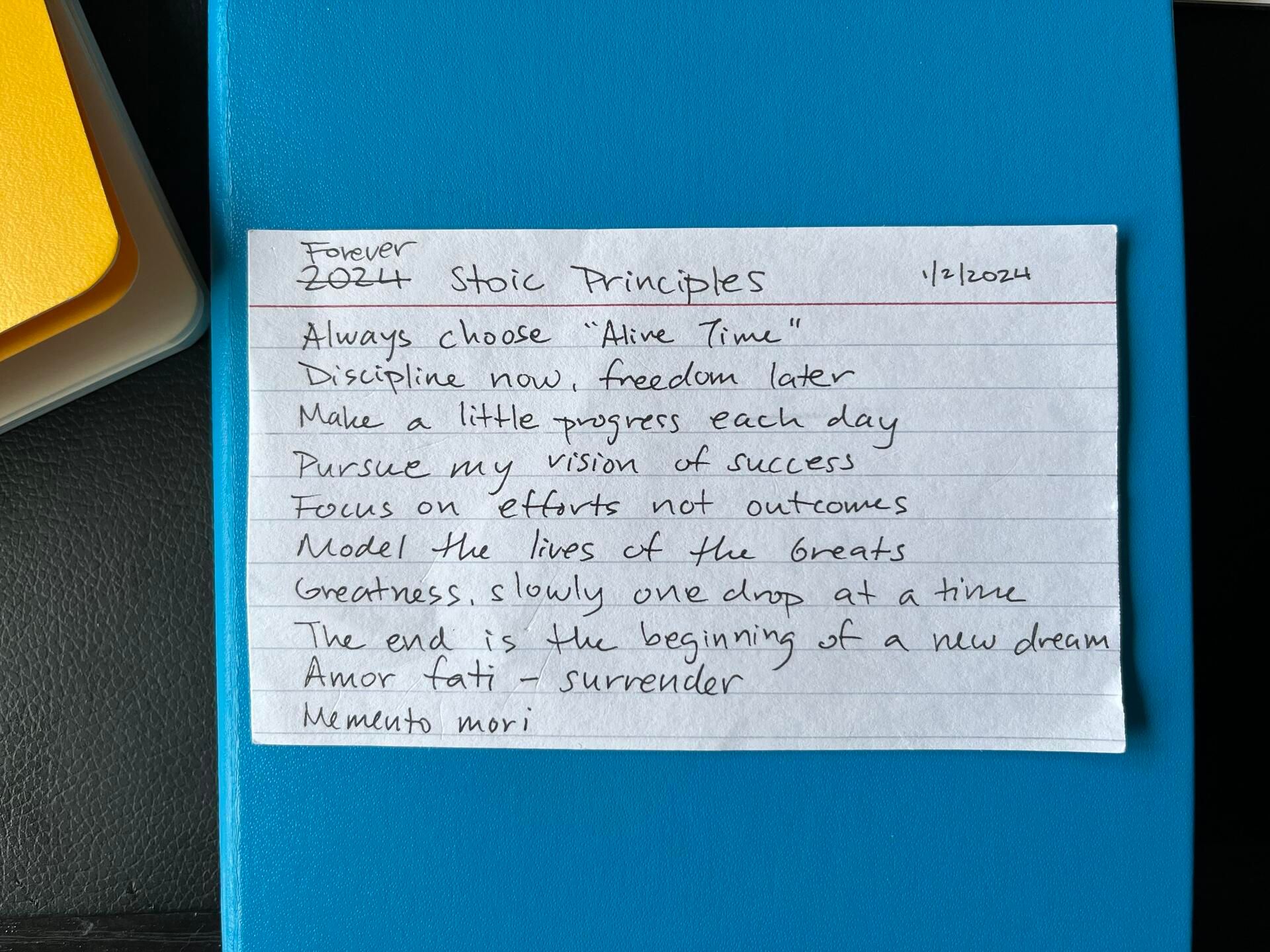
My Forever Stoic Principles to help me stay focused. What are yours?
So I wanted to articulate and share some simple disciplines that I have helped me sort through a lot of the noise.
Don’t trust, verify
You can start learning from the big names in the area you are interested in, but also start to look for lesser known smart people and thinkers who may have gotten lost in the noise.
My philosophy is that I can learn something from everyone, but it’s my job to verify what they are saying is true for me or not. This means investing the time to read the research, reading a book on the topic, listening to another perspective on the same topic, think through it, and ask follow up questions.
Often, you will hear experts you trust start to reference experts they trust. This is like the original hyperlinking before the internet. Note those names and look up their work.
Give health experts the benefit of the doubt, but once they lose that trust, you are allowed to stop listening. I will not just listen to what someone says, but also watch how they behave and whether they demonstrate good character consistently over time. Eventually, you will be able to fine tune your BS filter.
Beware of "one-itis"
It’s important to expose ourselves to a variety of sources of information and ways of thinking. Algorithm-based media like social media will start to tailor our feeds based on past viewing behavior or based on what the algorithm wants you to watch more of.
Over time, our feeds can lead us down a rabbit hole of information that confirms and reinforces our own biases. Let’s face it, social media is the place where capturing your attention is a higher priority than giving you the nuanced truth.
Periodically look outside of your normal sources and see what opposing voices are saying. It’s a good reality check to not get stuck in cognitive tunnel vision. It’s also important to find people and communities in real life from a human being you know is not a bot.
Better yet, read books and listen to long-form podcasts. I find that almost everything on my social media feed is like an incomplete, half-baked thought interspersed with cute cat content (which I am particularly susceptible to).
Over time, you can start to triangulate the different sources and land close to the truth.
Also, make sure your reality does not exist solely in the virtual world and get outside in nature regularly to recalibrate your senses.Prevent making stupid decisions with first principles thinking
First principles refers to fundamental truths, laws, or assumptions that serve as the foundation for a system of beliefs, behavior, or reasoning.
We are most vulnerable to false information when we look to experts to just tell us what to do or to give us the right answer based on their principles. We might be operating from a conflicting set of principles, and those principles could be just wrong.
When we develop our own set of principles, we can start to filter new information to help us decide whether or not something makes sense for us.
For example, I learned medicine through the lens of naturopathic principles—first do no harm, identify and treat root causes, doctor as teacher, treat the whole person, and prevention.
Principles are a filter that I use and have learned to trust over time, and I am continuously evaluating and verifying that these principles continue to be true. When new information contradicts these principles, it raises a red flag and helps me be more discerning.Follow the money and incentives
The investor Charlie Munger often repeated an important principle—human behavior is always driven by incentives.
In the case of Peter Attia, it seems that at the very least he was incentivized to be close to powerful people and may have received a lot of money from people who had ties to institutions that then influenced what he said or did not say on his platform, which millions of people then based their own health decisions on. It brings into question all of his work, even he did share some useful information.
What is being revealed now is that many of the suddenly famous were in some way financially compromised or constructed to rise to the top. Not all, but be wary of those who seemingly became famous overnight with no clear track record.
When we listen to experts, it’s important to start to evaluate what is in it for them—and ask, "Does this person’s advice come from incentives that conflict with what is best for me?"Find great teachers and friends that help think more accurately
My most impactful teachers and friends never told me what to think.
They taught me how to think more accurately and make better decisions. They often did this by allowing me to observe how they solved problems and thought through different scenarios. I was able to take the best of what they taught and leave the rest that was not applicable to me.
Be wary of those who are absolute in their thinking and in their advice for what you should do. The people I have learned to trust are often the most intellectually honest, humble, and curious. Real friends and family are willing to tell you how stupid you are being 🙂 .
This can be a dark and ugly rabbit hole, and I acknowledge you for sitting with the discomfort of willing to face life’s ugly realities.
Despite all this seeming darkness being revealed, I still believe that there is much light and good in this world.
Stay vigilant and control what you can control.
Go online to get information, but remember to go offline and take a long walk outside to make sense of it all.
P.S. Do you or someone you care about want guidance and a blueprint for simple disciplines that will help you navigate a complex health landscape?
Schedule a consult here https://l.bttr.to/uYxzi or reach out via email.